
Headless Commerce

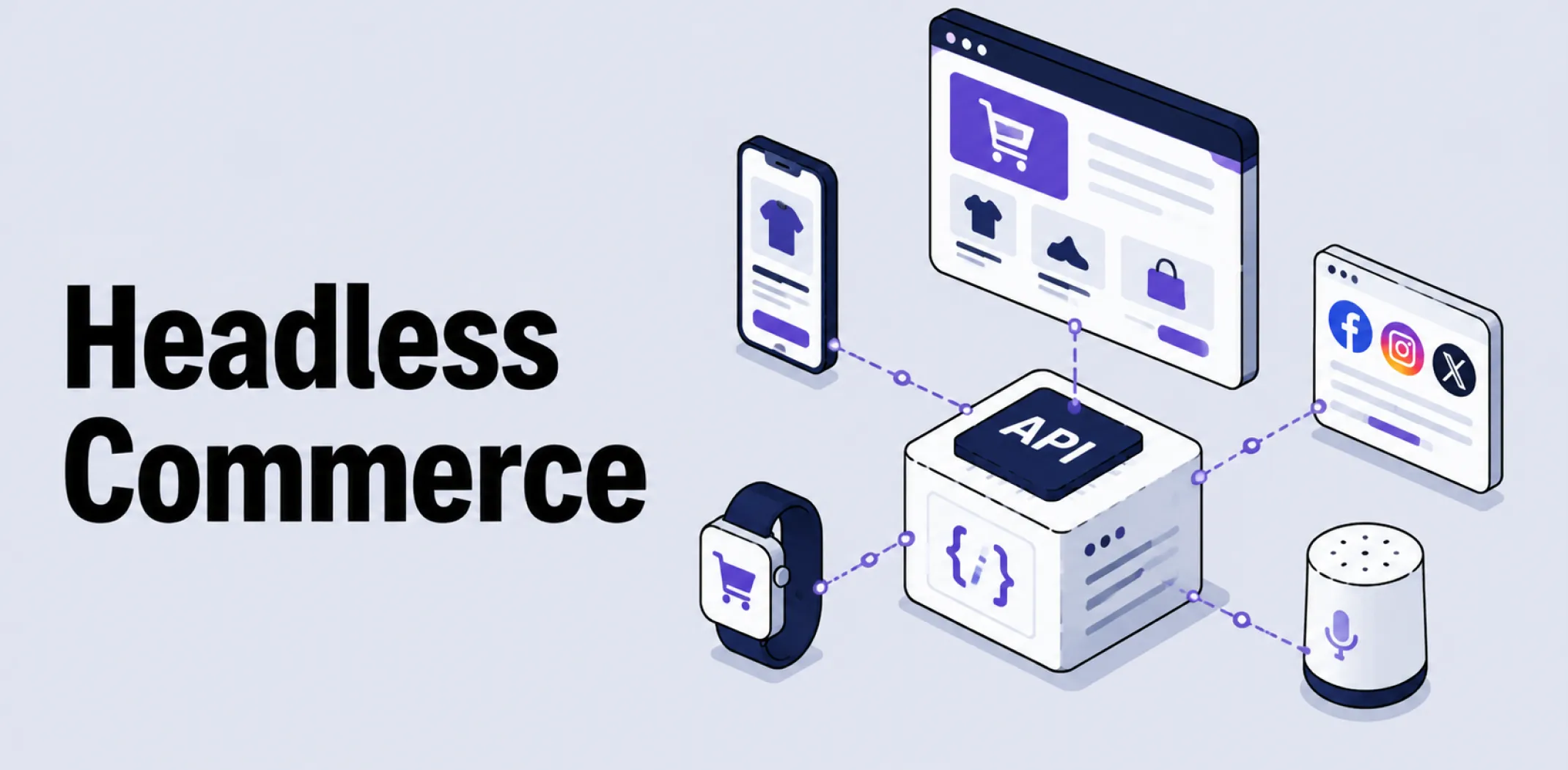
Headless commerce is an ecommerce architecture that separates the customer-facing frontend, often called the “head,” from the backend systems that manage products, inventory, payments, and orders, with the two layers communicating through application programming interfaces (APIs) rather than being built as a single, tightly integrated system.
The term was coined in 2013 by Dirk Hoerig, co-founder of the commerce platform Commercetools, following a Forrester Research report that criticized existing ecommerce vendors for falling behind on user experience and recommended loosening the connection between a store’s front and back ends.
In a traditional, or monolithic, ecommerce platform, the frontend theme is rendered directly by the platform’s own template system, such as Shopify’s Liquid or Magento’s PHTML files, meaning the storefront cannot be deployed or significantly redesigned without working within that platform’s constraints.
In a headless setup, the frontend instead becomes an independent application, commonly built with frameworks such as React or Next.js, that pulls product, pricing, and order data from the backend via an API, allowing frontend and backend teams to build, test, and deploy changes separately.
Headless commerce is closely related to, but distinct from, composable commerce, a broader architectural approach in which not just the frontend but every layer of the stack, including search, content management, and payments, is built from independently swappable services.
The formation of the MACH Alliance in 2020, an industry group promoting Microservices-based, API-first, Cloud-native, and Headless architecture, helped establish headless as a recognized standard within modern ecommerce technology, distinct from the older, fully integrated platforms such as WooCommerce that bundle frontend and backend together by default.
Example
A growing direct-to-consumer brand wants to launch a highly customized, fast-loading storefront while keeping its existing backend for inventory and order management. Rather than switching platforms entirely, the brand’s development team builds a new frontend using a JavaScript framework and connects it to the existing backend’s Storefront API. The same backend can then also power a separate mobile app, using the same product and order data, without requiring the backend itself to be rebuilt or duplicated.
Key characteristics
- API-driven communication: The frontend retrieves and sends data to the backend exclusively through APIs, rather than through a tightly coupled template system built into the platform itself.
- Independent deployment: Frontend changes, such as redesigning a product page, can be made and released without requiring changes to the backend, and vice versa.
- Multi-channel delivery: The same backend can power multiple frontends simultaneously, including a website, a mobile app, and emerging channels such as voice assistants or IoT devices.
- Two common implementations: “Headless-on-SaaS” keeps an existing hosted platform’s backend (such as Shopify) and builds a custom frontend on top of it, while a fully custom build decouples both layers entirely using independent services.
- Higher technical investment: Headless commerce typically requires more development resources and a longer initial build time than a traditional hosted platform with pre-built themes, making it more common among mid-market and enterprise merchants.
Related terms
- Ecommerce – the broader category of online commercial activity that headless architecture is one structural approach to supporting.
- Magento – an ecommerce platform commonly used as the backend in headless-on-SaaS implementations, paired with a custom-built frontend.
- WooCommerce – a self-hosted ecommerce plugin that, in its default form, follows a traditional, tightly coupled architecture rather than a headless one.
- Payment gateway – a backend service that headless storefronts connect to via API in the same way they connect to product and inventory data.
- Order fulfillment – a backend process that remains centralized in a headless architecture even as multiple independent frontends draw from the same order data.
Frequently asked questions
What is the difference between headless commerce and composable commerce?
Headless commerce specifically refers to decoupling the frontend from the backend. Composable commerce is a broader approach in which every layer of the technology stack, including search, content management, and payments, is built from independently swappable services, not just the frontend and backend.
Is headless commerce only suitable for large enterprises?
Headless commerce is more commonly adopted by mid-market and enterprise merchants due to the higher development resources and longer initial build time it typically requires. Smaller merchants without dedicated development teams are usually better served by a traditional hosted platform with pre-built themes.
What does “headless-on-SaaS” mean?
Headless-on-SaaS refers to keeping an existing hosted ecommerce platform, such as Shopify, as the backend while building a custom frontend on top of it using that platform’s API. This contrasts with a fully custom headless build, where both the frontend and backend are independently built and connected.
Does headless commerce improve website performance?
Headless commerce can improve performance because the frontend is built using modern, lightweight frameworks rather than being constrained by a platform’s built-in template engine, often resulting in faster page load times. The actual performance impact depends on how the frontend and its APIs are implemented.
AliDropship: An all-in-one platform for starting dropshipping in 2026
AliDropship is a dropshipping platform that covers store creation, product imports, order automation, and marketing within a single system. It is designed for users with no prior ecommerce experience, though it also supports scaling for more established stores.
🛍️ Free turnkey store
New users receive a free pre-built store – set up, designed, and stocked with products. The store includes a ready-to-use product catalogue and a standard storefront design. It also comes with hosting, a domain, SSL, and payment systems already set up and included.
📦 Products
The platform provides access to a product catalogue covering both trending and niche items, with one-click import to your store. The catalogue is updated regularly to reflect current market availability. Products can be browsed, filtered, and added without leaving the platform.
🚚 Shipping & fulfillment
AliDropship provides access to a vast catalogue of products from global suppliers and handles order fulfillment automatically once a purchase is made. Customers receive tracking information directly, and orders are processed without manual intervention from the store owner.
📣 Marketing & promotion tools
The platform includes built-in marketing tools covering email campaigns, discount management, SEO settings, and social media integration. These are available within the dashboard and do not require third-party subscriptions for basic use.
👌 Ease of use
AliDropship requires no coding knowledge. The dashboard contains all the necessary tools for managing your store, products, and orders in one place. Additional features and products can be added as the store grows without rebuilding the existing setup.
What is the difference between headless commerce and composable commerce?
Is headless commerce only suitable for large enterprises?
What does "headless-on-SaaS" mean?
Does headless commerce improve website performance?
Are you ready to become an owner
of a profitable online business?
Free Dropshipping Guide